All projects
Agent-built productJuly 2026Reported by the owner
Purchase captured in seconds, points pooled across branches
Built for
Alchemist Pharmacy's branch staff and admin
Project
Alchemist customer database
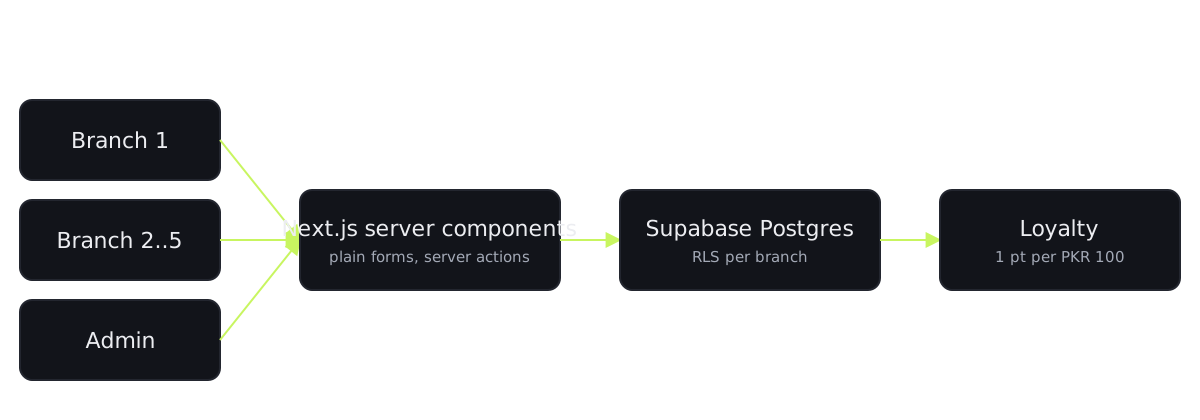
Phone number finds or creates the customer, amount records the sale, 1 point per PKR 100 accrues org-wide. Each branch sees only its own sales through Postgres row-level security; admin sees all. Near-zero client JavaScript.
02
Demo
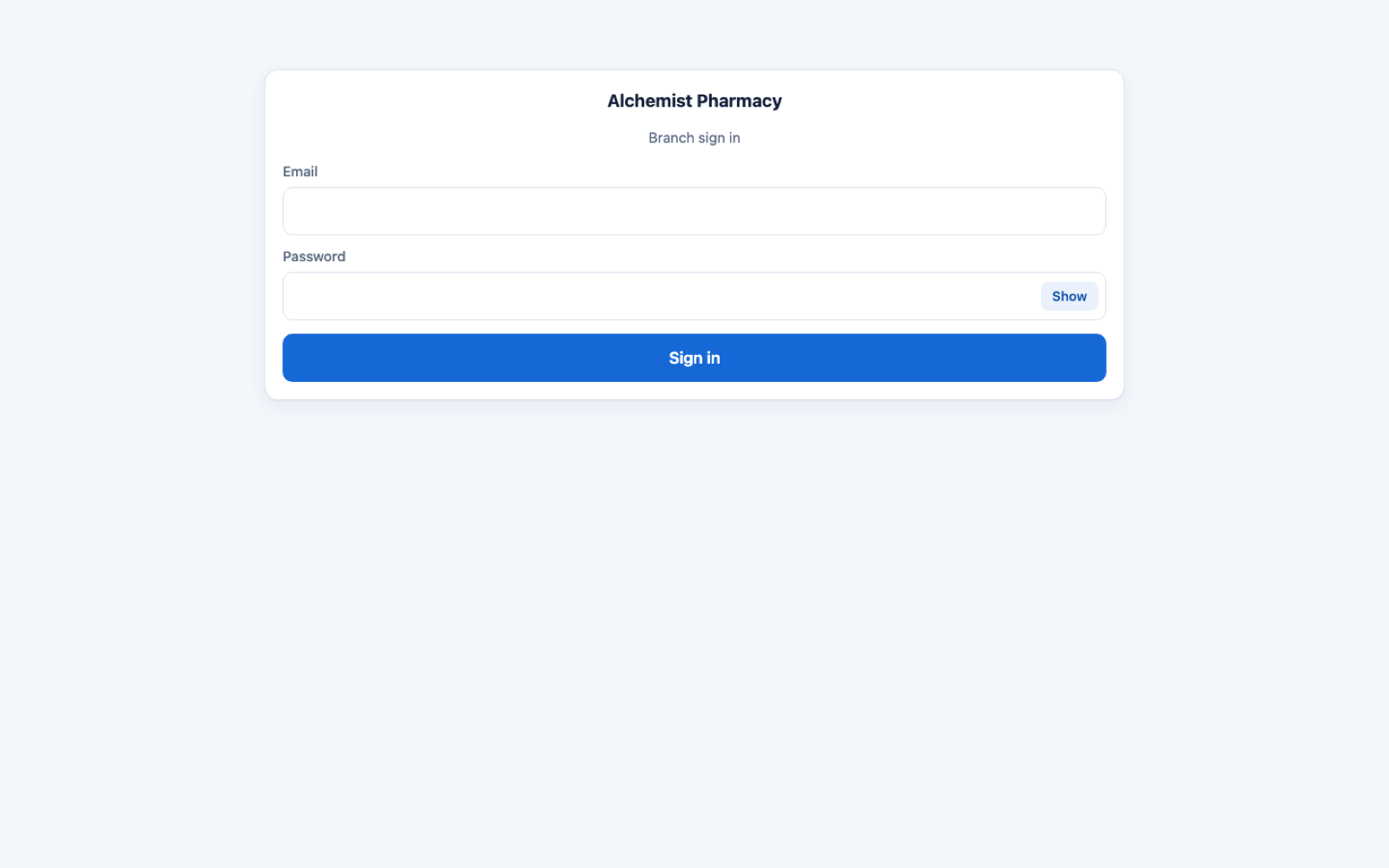
Live, behind a branch login.Open live ↗
03
How it works
01
Server Components and plain HTML forms so pages work on a flaky connection.
02
Four dependencies total; no UI framework, system fonts.
03
RLS policies enforce per-branch isolation in the database, not the app.
04
No line-item data stored: privacy by design; inactive customers purged after five years.
05
Stack and code
- Next.js
- Supabase
- Postgres RLS
- Server Actions
- Vercel
0002_functions_rls.sql— Functions and row-level security.
-- 0002_functions_rls.sql — helper functions, loyalty engine, RLS policies
-- See stages/02_design/output/design.md §4 and §5.

-- ---------------------------------------------------------------------------
-- Identity helpers. SECURITY DEFINER (owned by postgres) so they read profiles
-- without triggering RLS recursion.
-- ---------------------------------------------------------------------------
create or replace function public.current_branch_id()
returns uuid language sql stable security definer set search_path = public as $$
  select branch_id from public.profiles where id = auth.uid();
$$;

create or replace function public.is_admin()
returns boolean language sql stable security definer set search_path = public as $$
  select exists (
    select 1 from public.profiles where id = auth.uid() and role = 'admin'
  );
$$;

-- ---------------------------------------------------------------------------
-- Loyalty engine
-- ---------------------------------------------------------------------------
-- Earn: 1 point per PKR 100 (floor). Set on the row, then mirror into ledger.
create or replace function public.set_purchase_points()
returns trigger language plpgsql security definer set search_path = public as $$
begin
  new.points_earned := floor(new.total_amount / 100);
  return new;
end $$;

create or replace function public.ledger_earn_on_purchase()
returns trigger language plpgsql security definer set search_path = public as $$
begin
  if new.points_earned > 0 then
    insert into public.loyalty_ledger (customer_id, type, points, purchase_id, branch_id)
    values (new.customer_id, 'earn', new.points_earned, new.id, new.branch_id);
  end if;
  return new;
end $$;

drop trigger if exists trg_set_purchase_points on public.purchases;
create trigger trg_set_purchase_points
  before insert on public.purchases
  for each row execute function public.set_purchase_points();

drop trigger if exists trg_ledger_earn on public.purchases;
create trigger trg_ledger_earn
  after insert on public.purchases
  for each row execute function public.ledger_earn_on_purchase();

-- Redeem: 1 point = PKR 1, minimum balance 100 to redeem. Locks the customer's
-- ledger rows so the balance can never go negative under concurrent use.
create or replace function public.redeem_points(p_customer uuid, p_points int)
returns int language plpgsql security definer set search_path = public as $$
declare
  v_balance int;
  v_branch  uuid;
begin
  if p_points <= 0 then
    raise exception 'Points to redeem must be positive';
  end if;

  -- serialize concurrent redemptions for this customer
  perform 1 from public.loyalty_ledger where customer_id = p_customer for update;

  select coalesce(sum(case when type = 'earn' then points else -points end), 0)
    into v_balance
  from public.loyalty_ledger where customer_id = p_customer;

  if v_balance < 100 then
    raise exception 'Minimum 100 points required to redeem (balance: %)', v_balance;
  end if;
  if p_points > v_balance then
    raise exception 'Insufficient points (balance: %, requested: %)', v_balance, p_points;
  end if;

  v_branch := public.current_branch_id();
  if v_branch is null then
    raise exception 'No branch context for redemption';
  end if;
github/alchemist-customer-db/supabase/migrations/0002_functions_rls.sql
HOW_IT_WORKS.md— How capture and loyalty work.
# Alchemist Pharmacy — Customer Database & Loyalty: How It Works

A plain-language guide to what this system is and how every page works. For
setup/deploy steps see [`README.md`](README.md).

---

## 1. What this is

A small, fast web app that lets **pharmacy counter staff record who bought
something, how much they spent, and at which branch** — and runs a **loyalty
points** program on top of that. It sits *alongside* the branches' existing POS
billing software (which we can't access), capturing just the customer + sale
info the pharmacy wants to keep and reward.

**Why it exists**
- Keep a reliable record of customers and their spending across all branches.
- Reward repeat customers with loyalty points that work at *any* branch.
- Give head office real reporting: who's buying, how much, and where.
- Build the purchase history that a future subscriptions product can use.

**What it deliberately does *not* store:** the actual medicines/items on a
receipt. Only the **total amount** is recorded — never line items or drug names.
This keeps the system out of sensitive "health data" territory on purpose.

---

## 2. The two kinds of user

| Role | Who | What they can do |
|------|-----|------------------|
| **Branch** | Counter staff at one branch (one shared login per branch) | Look up/enroll customers, record sales for **their own** branch, redeem points, see **their own** branch's sales |
| **Admin (Head Office)** | The owner / management | Everything a branch can, **plus** see every branch's sales, an all-customers report, and manage branches + branch logins |

Every branch has a unique ID. When a branch is logged in, every sale it records
is automatically stamped with that branch — staff never pick it from a list, so
it can't be mis-attributed.

---

## 3. The technology (in one paragraph)

It's a **Next.js** app hosted on **Vercel** with a **Supabase** (Postgres)
database. The important design choice: **all the security rules live in the
database itself** (Postgres "Row-Level Security"), not just in the app. So even
if the app had a bug, one branch still could not read another branch's sales.
The app is built to be **very lightweight** for slow internet — pages are mostly
plain HTML with almost no JavaScript.

---
github/alchemist-customer-db/HOW_IT_WORKS.md